Gallery and Curation
Post Office Margate Gallery, 22-23 Cecil Square, Margate, CT9 1BA, Kent. UK.
Kavel Rafferty @projects_kavelrafferty is based in the iconic Post Office building on the corner of Union Cresent and Cecil Square in the centre of Margate.
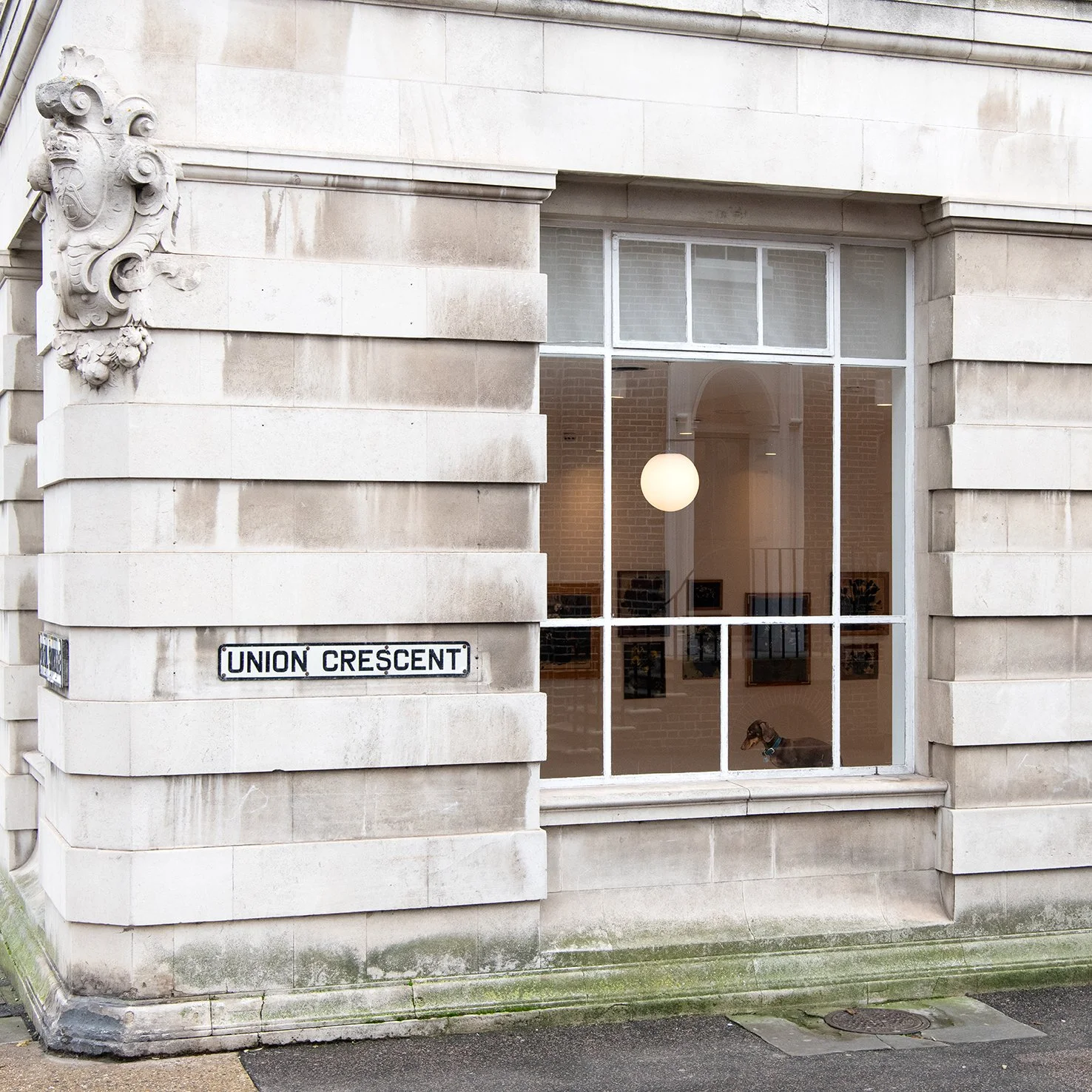
Projects Kavel Rafferty aims to champion the work of women, queer, outsider and self-taught artists as well as showing her own work at the Gallery Spaces in Margate. Kavel has a post punk DIY ethos for exhibitions and curating. Her exhibitions are unpretentious and exuberant. She is inspired by the community she lives in, her program hopes to reflects this down to earth attitude. Her shows are accessible, egalitarian and inclusive.
The gallery encourages direct connection between the public, community, collectors and artists.
Please email Kavel if you are interested in hiring the space, for exhibitions, filming, photography and events.
Kavel has worked with Margate Pride, Headway Thanet, Refugee Week, The Turner Contemporary and Power Of Women Thanet.
Coming soon… ‘The Gardener’ 13th - 29th November 2026
Rose Blake and Kavel Rafferty co-curate a group show exploring the parallels between the artist and the gardener.
Alexandra Duprez, Ellie MacGarry, Florence Hutchings, Gavin Shepherdson, Gráinne Nagle, Kavel Rafferty, Mark Beldan, Mike S Redmond and Faye Coral Johnson, Peter Judson, Rose Blake
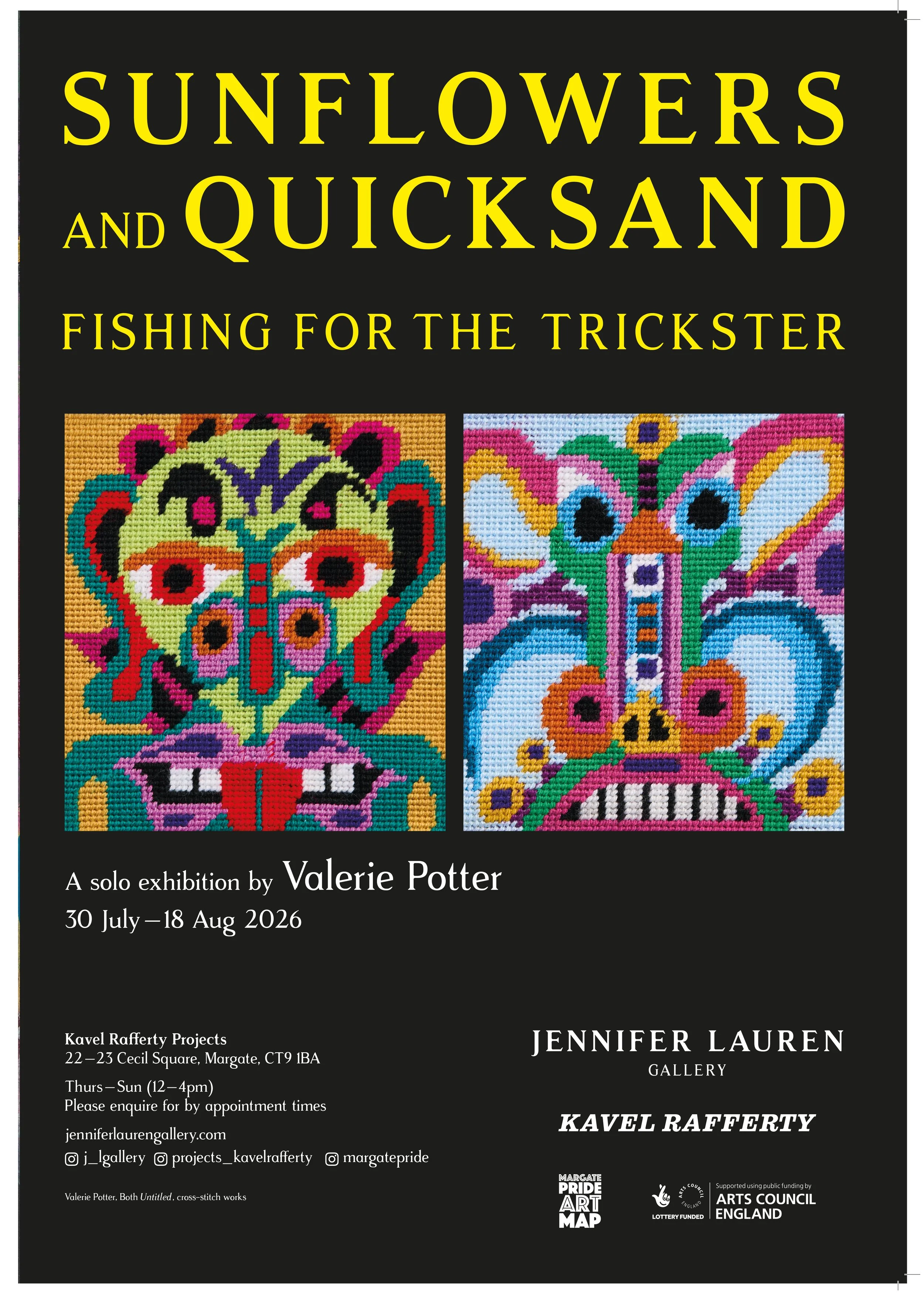
‘Sunflowers and Quicksand: Fishing for the Trickster’
A Solo exhibition from Valerie Potter. Exhibition runs: 30 July – 18 August 2026 Part of Margate Pride Art Map
‘The trickster is the rather mercurial force that makes me create, the sunflowers are when the trickster works with me and the quicksand is when he is being capricious and leading me down the garden path’
The inspiration for a solo exhibition by local self-taught artist Valerie Potter showcasing works in stitch, drawing and painting, ranging from the eighties to the present day. With pieces revealing fantastical landscapes and microscopic worlds fuelled by the artist’s love of botany; tying together symbols of birth, death and love with non-religious iconography. Prepare to see Vikings frolicking in space, a pig man growing wings, and two kidneys having a good time ... this exhibition is one not to be missed, delving into the remarkable, unconventional mind of Valerie Potter.
Biography - Although always creative, Potter did not consider herself an art-maker. She was born in Kent in 1954, but spent her formative years in Nigeria and Jamaica, moving around due to her father’s work commitments as a teacher and educator. Her love of pattern and vibrant colours stems from the vast array of fruit, vegetation, and fabrics she observed whilst living in these countries. At 19, Potter enrolled at art school, but found it restrictive and left, continuing her drawing at home. When she caught sight of a stranger, cross-stitching on a local train platform, she considered whether fabric might give her more freedom and portability. It was a moment of realisation; and it led the artist to explore a new and exciting format. A fortuitous find in a bookshop of esteemed art historian Roger Cardinal’s 1972 Outsider Art book inspired her to contact him and share some of her drawings. He was so impressed by her work that he introduced her to a collector and a gallerist and organised her first exhibition. The solo show – which was presented in 1985 at the University of Kent – marked the start of an artistic career that has seen Potter’s drawings, paintings and embroideries exhibited at numerous galleries including the Irish Museum of Modern Art (Dublin, UK), Whitechapel Gallery (London, UK), Whitworth Museum (Manchester, UK), Tate Britain (London, UK), and Carl Freedman Gallery (Margate, UK). Potter continues to live and work in Margate, where she also writes poetry and knits. She is represented by the Jennifer Lauren Gallery, Manchester. “I don’t know what I would have been if it hadn’t been for creativity.”
About Margate Pride – An arts-led celebration rooted in community, creativity, and care. Ten years of championing a non-corporate and environmentally conscious approach, it centres queer voices, creating space for authentic expression and connection. Supported by Arts Council England, the programme highlights the power of grassroots culture to inspire inclusivity. The Pride Art Map is an integral part of Margate Pride. Curated by local artist and gallery owner Kavel Rafferty. During two weeks in August the town becomes a gallery for LGBTQ+ talent.
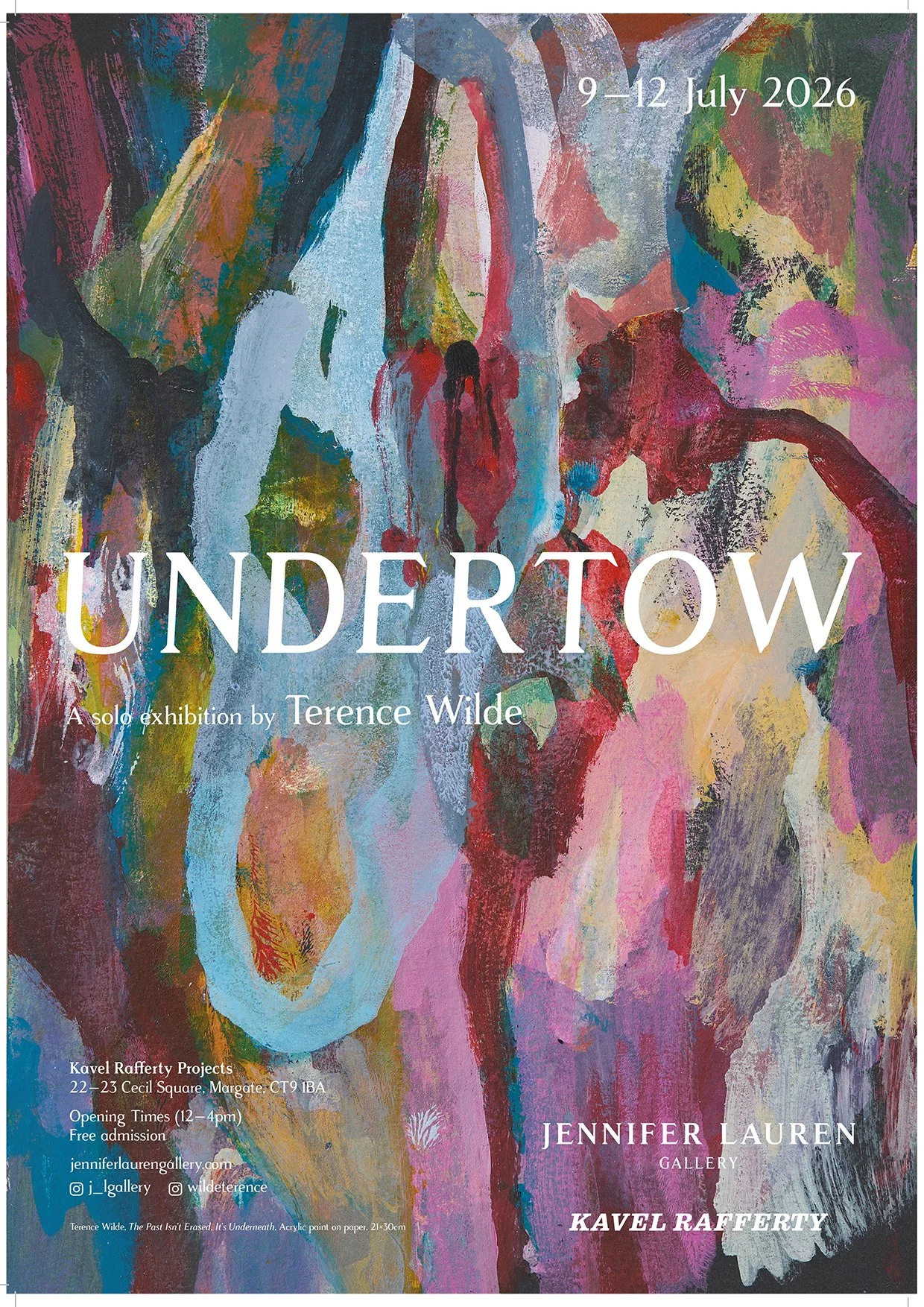
‘Undertow’ – A solo exhibition by Terence Wilde
Dates: 9 – 12 July 2026
“It is the beautiful, it is the strange. It's what remains, after the sea takes everything, and gives it back, rearranged.”
Much of the work featured in this exhibition is based around ideas, art and ceramics made during Terence Wilde’s Arts Council England funded DYCP project, which he embarked on in August 2025. The original working theme of clay, scale and spirituality has led him through the elements to the undertow of the sea, where he has begun to make art more from inside of an experience, rather than about one. Wilde wanted to work from a clearer psychological space by providing himself with a more private physical environment. The work recently created is from learning to use the language of self-acceptance where both joy and grief occupy the same space, and where the push and pull of chaos and order co-exist in a more expansive fluid state. The underlying concept of the work is in bridging the organic (coral), the crafted (China) and the human (faces and form.) To create a layered metaphor for resilience through vulnerability and to explore the persistence of forms that adapt and hold together despite pressure. His poetic vision is to capture something half remembered from within the psyche, a dream or an outsider sculpture, embedded with history and haunting intimacy. A sculptural relic, dredged from the deep, encrusted with time, memory and discarded beauty, personal but alien, where gestures and impressions overlap and dissolve within a body that wears the marks of struggle. The pattern making and text used in his work simultaneously conceal and reveal experience, showing what has been removed and reclaimed, which parts of the soul have been mapped and pressed into form.Through affording specific time to reflect, in working more with clay and using to a water archetype, Wilde has gained new perspectives into his life as both an adult survivor and visual artist, with a newfound magical feeling of emotional release and unrestricted honesty. Working in the realm of ‘Undertow,’ he is learning to reconsider the past without stepping away from it and return with the courage to show rawness, a plea for survival and embrace the struggle to form or hold onto a stable sense of self. Wilde’s work continues to embody shadow material and visualises inner conflict and transformation but is becoming strongly anchored in the paradox of a shifting identity alongside an acceptance of impermanence. Undertow, a sensation of being pulled under the surface, is a last attempt at containment against surrounding chaos. Seductive and dangerous, mimicking the disorientation of being submerged.
Biography Terence Wilde (b.1963) is a visual artist based in London. He gained a degree in textiles at Winchester School of Art and used this to work as a fashion print designer in the West End for many years. He then retrained through Croydon's voluntary mental health services. It was here that he was able to use his creativity to help people express themselves and he still does this today within a hospital setting. Wilde draws on his own mental health journey, from the perspective of an adult survivor, in all his black and white works. Working mainly in pen drawing or ceramic, Wilde describes his works as responses to different periods in his life and personal situations. They show struggles, fears and dreams, and help Wilde to heal and to make sense of his life at any given time. Wilde’s work has been widely exhibited including in group exhibitions at the Royal Academy of Arts, London; Pallant House Gallery, Chichester; Carl Freedman Gallery, Margate; and in The Box at Pippy Houldsworth Gallery, London. In 2024 Wilde won an award at the inaugural Cass Art Exhibition at Copeland Art Gallery, London. He is represented by the Jennifer Lauren Gallery, Manchester.
‘Removals’ unread - Kavel Rafferty
I Paint Over Things
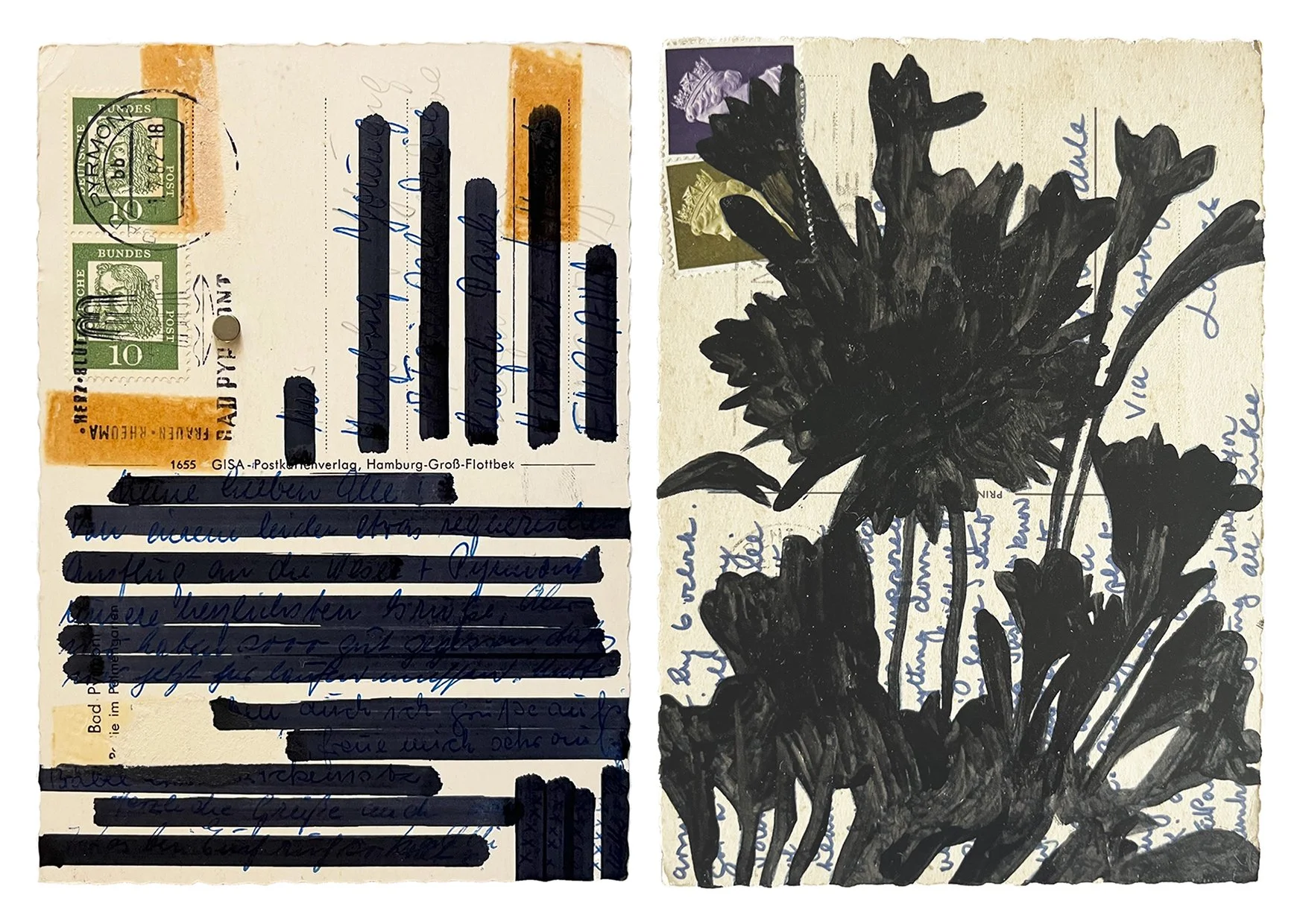
This postcard installation is about removal in many forms. Text messages have largely replaced postcards, and I miss them. I've always been interested in postcards. For me, they sit somewhere between a private message and a public object. There is a particular joy in receiving an unexpected note through the letterbox. Once a common way to keep in touch, postcards now feel like fragments of a slower time. For this series, I work with found postcards. Banal holiday weather reports, thank-you notes, names, places, and everyday messages are covered over with paint and pen until they can no longer be read. I transform these overlooked objects into artworks. What is left when the information disappears? By removing the text, I shift the focus from communication to absence. The obscured images and text recall acts of censorship and redaction, where language is hidden, controlled, or lost. What cannot be read becomes as significant as what remains visible.
Just Like Abroad’ is a collection of altered postcards. I have left only the word Weather, deleting everything else. Talking about the weather is often considered a national British obsession, yet when I lived in Sweden people talked about the cold, and in Spain they talked about the heat. Each postcard bears a Machin stamp, designed by Arnold Machin in 1967 and used until the death of Queen Elizabeth II in 2022.
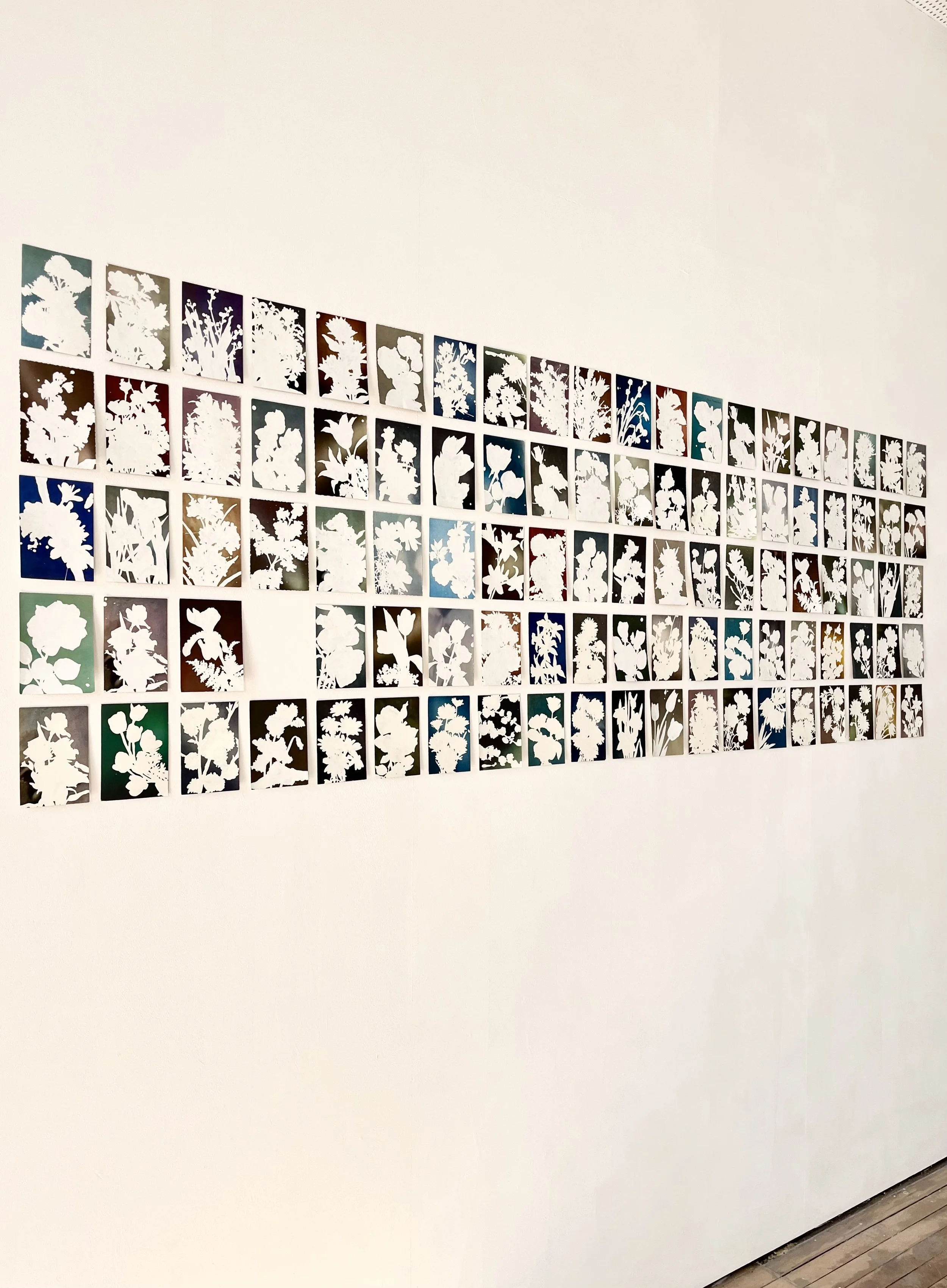
‘Hi Everybody’ is a group of redacted postcards arranged as blocks reminiscent of high-rise buildings. Each postcard is similar, yet subtly different, made individual by the handwriting of a stranger and my intervention. Together they create patterns and rhythms. A kind of visual poetry that emerges through concealment. The arrangement is determined by chance: each block is placed as it emerges from the shuffled pile. ‘99 Flowers for Peace’ is a series of postcards redacted with white enamel paint. Again removing information to create new images and meaning. Across cultures white flowers represent emotional clarity, harmony, and remembrance.
‘What's on the Front’ Painted on the Back. Palimpsests, painting over the original text, with floral motifs, front to back rather than back to front.
‘SONG OF A DOZEN DISHES’ Vivien Lee & Elizabeth Magill
11 April – 3 May 2026
Projects Kavel Rafferty is pleased to present Song of a Dozen Dishes, a two-person exhibition by Vivien Lee and Elizabeth Magill. The artists’ relationship began with Magill’s exhibition Well (2020), held at Penthouse, Margate an artist-run space founded and curated by Lee. From this initial encounter, a sustained conversation developed, shaped by gestures of generosity and correspondence, including the sharing of books, images, and references. Though culturally distinct, Lee and Magill share formative connections to island geographies shaped by colonial histories. Lee, who was born in Taiwan, and Magill, who grew up in the north of Ireland, each draw upon early experiences of places marked by external political authority and complex social conditions. These histories continue to inform their practices, where landscape, memory, and identity are closely intertwined. Both artists relocated to the United Kingdom to pursue their studies and have remained based there.
The exhibition’s title is drawn from Taiwan Travelogue by Taiwanese writer Yang Shuang-Zi, a book gifted from Lee to Magill, in which the story is told by a Japanese writer reflecting on Taiwan through its culinary traditions and social encounters. The text prompted a shared interest in the idea of food as a language of care and communication where recipes and dishes function as repositories of memory, gestures of offering, and expressions of relationship.
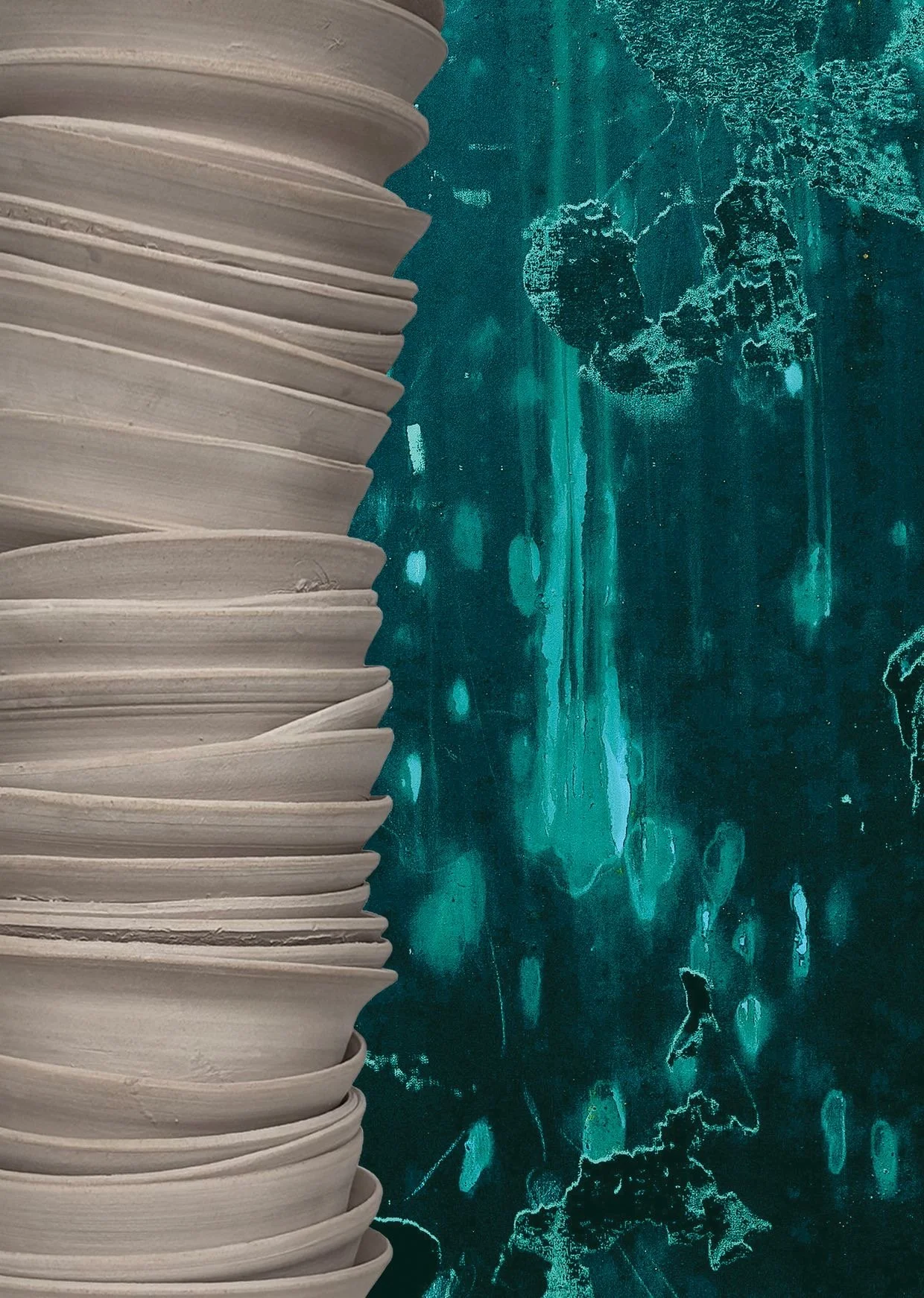
Lee’s contribution comprises a circular, table-like plinth supporting arrangements of hand-thrown, unglazed stoneware bowls. Each grouping signifies a person, place, or connection - family, friendships, and cultural inheritance. The works operate as vessels of memory, reflecting Lee’s ongoing exploration of how food and making can evoke personal histories and sensory experience.
Magill presents a body of paintings that combine silkscreen and traditional techniques across large and small formats. Drawing on recollections of the scenic landscapes of the north of Ireland, her works evoke shifting atmospheres in which natural beauty is interwoven with psychological and historical depth. Trees and horizons recur as motifs, suggesting both rootedness and distance, presence and absence.
Elizabeth Magill is represented by Kerlin Gallery, Dublin; Miles McEnery Gallery, New York; and in London by Annely Juda Fine Art and Anthony Wilkinson Gallery. Her work is held in major public collections including Tate, the British Museum, and the Arts Councils of England and Ireland.
Vivien Lee (b. 1978, Taiwan) lives and works in Margate.
Elizabeth Magill (b. 1959, Canada) lives and works in London and Ireland.
‘Unarranged’ A modern take on the still life.
Barbara Ryan Amsterdam and Kavel Rafferty Margate.
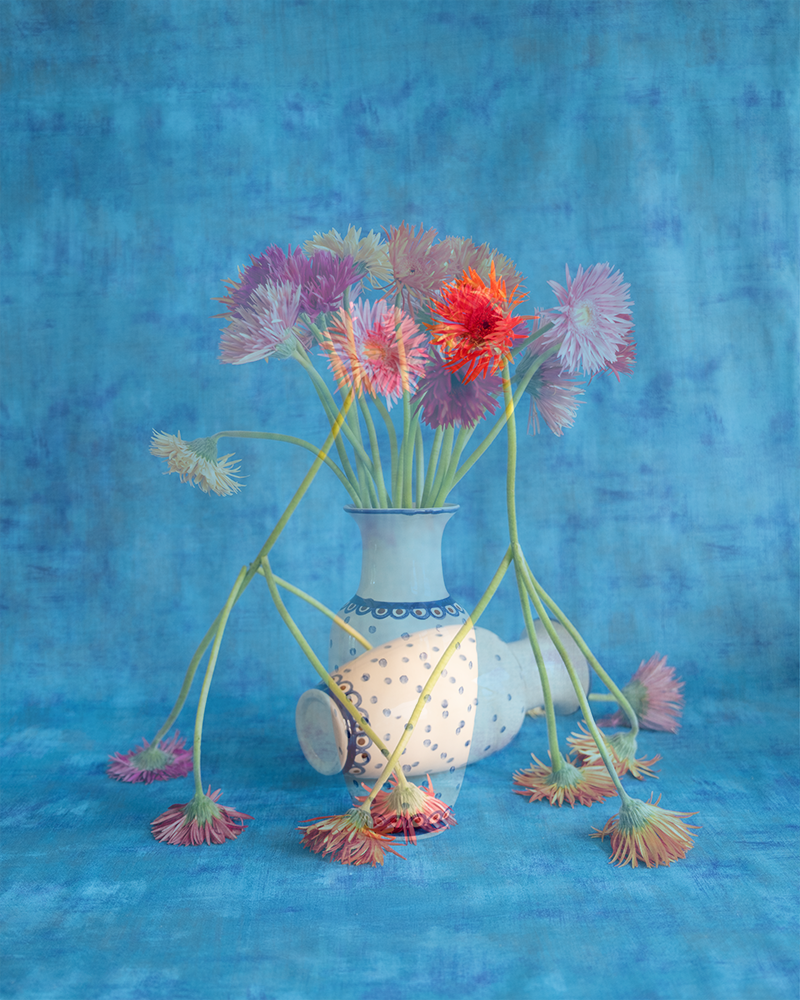
Although the artists live in different cities and come from different generations, a shared fascination with flowers and the stories they conceal brings them together for this show. In ‘Unarranged’, they each explore subverting the still lifes genre, questioning arrangements, authorship, and the unseen forces at play beneath the surface.
Barbara Ryan’s new series imagines flowers as possessing their own agency and desires, living, perhaps conspiring, behind our backs. What happens when they’re no longer performing for us, no longer held in place? Drawing on the textures and formal compositions of historic still life painting, Barbara uses lenticular printing to animate the moment flowers shift, actively unarranging themselves. The works ask us to consider how much control we ever really have over the things we try to contain or curate.
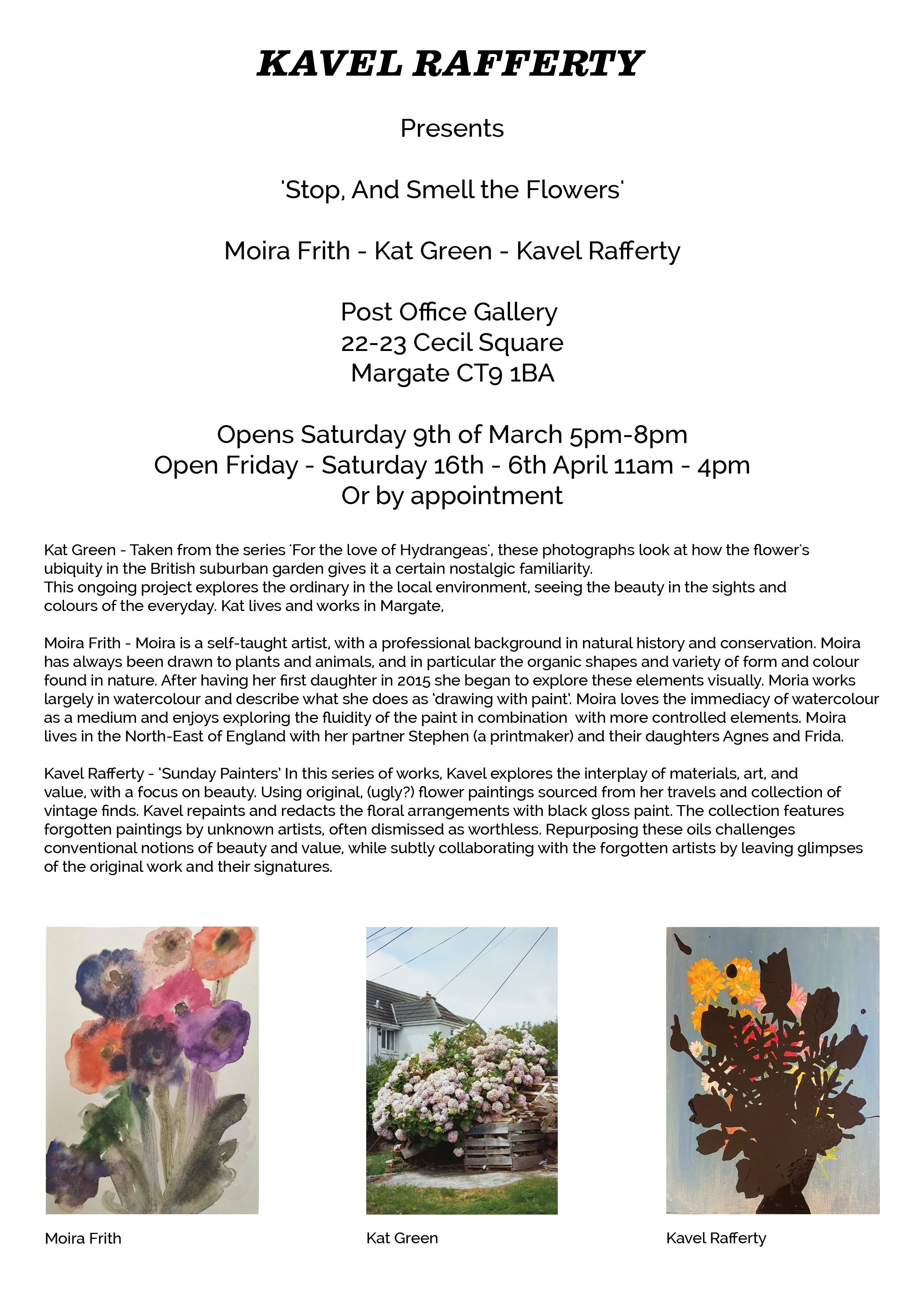
In contrast, Kavel Rafferty’s work takes a more tactile, sculptural approach, dipping floral arrangements into dripping black rubber, freezing them mid-transformation. Alongside these sculptural pieces are redacted still life paintings: original artworks sourced from charity shops and online marketplaces, where the flowers have been obscured with glossy black paint. Kavel’s process involves a form of quiet collaboration with forgotten or anonymous artists, challenging conventional ideas of authorship, beauty, and value.
While Barbara’s work is rooted in digital manipulation and the illusion of movement, Kavel’s approach is materially grounded, one teasing the viewer through visual trickery, the other through stark transformation. Together, their differing methods and materials offer a dynamic dialogue around control and the unseen lives of objects.
Projects Kavel Rafferty. 22-23 Cecil Square, Margate, CT9 1BA, Kent. PV Saturday 8th of November 5-8pm. Open Sunday 9th - Sunday 24th Friday Saturday and Sunday 12-4pm and by appointment.
James Taylor - Runt - Part of the Margate Pride Art Map 2025
Opening evening: 1st August 2025 18.00 - 21.00pm. Open 2nd August - 15th August 2025 12.00 - 16.00pm. Or by appointment.
Following acclaimed presentations at Second Act (London) and Paradise Works (Manchester), James Tailor returns with the third and most expansive iteration of Runt. Hosted as part of the Margate Pride Art Map, this version takes on a powerful new resonance—as both a celebration of LGBTQI+ history and a testament to queer resilience. Presented by a queer artist, this exhibition becomes not just a continuation, but a culmination of a deeply personal and political journey.
This rendition features assemblage sculptures, a newly composed sound piece, and an ambitious collection of 104 paintings from Tailor’s ongoing series of 30 x 26 cm canvases. The expanded scale intensifies Tailor’s exploration of marginalisation, endurance, and the inherent value of what society too often deems insignificant.
The title Runt—commonly used to describe the smallest or weakest member of a litter—embodies themes of vulnerability, neglect, and outsider status. While these ideas anchored the original exhibition, they gain new dimensionality here. The gallery becomes an immersive, layered space that invites viewers to reckon with the emotional architecture of the overlooked.
As the exhibition moves from city to city, it accrues new meaning. Each location shifts the context, echoing Tailor’s core inquiry: Who decides what is worthy? What does survival look like? The 104 small canvases form a collective chorus—fragmented memories that together amplify the voices of the unseen and unheard. Their repetition speaks to the power of persistence. Each piece, in its quiet singularity, contributes to a wider narrative of resilience, interdependence, and reclamation.
At the centre of the show stands a monumental sculpture—a visceral counterpoint to the intimacy of the paintings. As in previous renditions, this towering form serves as a physical embodiment of emotional and historical weight. It anchors the exhibition in a shared reality: that the personal and political are inseparable. This tension between the intimate and the immense mirrors the duality of queer experience—of being both hyper-visible and erased, of carrying both trauma and joy. Within the context of Pride, this interplay becomes even more potent, echoing the acts of resistance, reinvention, and visibility that define queer history.

‘Lean Into Joy’ - Kavel Rafferty
Open Friday - Sunday 27th October 17th November 12-4pm Or by appointment.
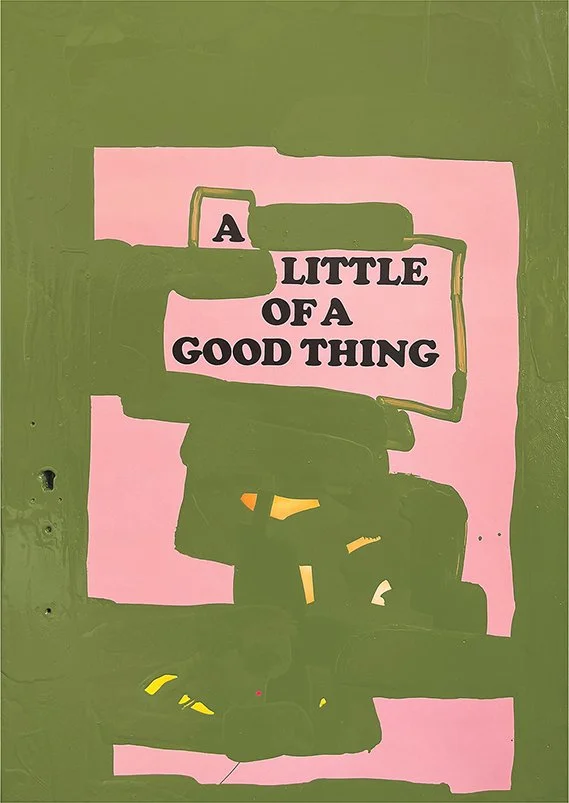
In Lean Into Joy, Kavel Rafferty explores the contradictions she has found in wellness culture, an affirmation overload and the pressures of toxic positivity. Using vintage posters and gloss paint, she redacts slogans—literally painting over the messages while leaving the words that she finds work, exposed—offering a wry critique of the sometimes banal self-help clichés and pseudoscientific platitudes.
These redactions, create abstract paintings, which frame the highlighted words. Rafferty gently mocks her own attraction to motivational mantras and quick-fix psychology. She acknowledges how seductive these messages can be, especially when navigating anxiety or low mood. But through her work, she questions their effectiveness—and their limits.
While she welcomes the destigmatisation of mental health and the increasing openness around therapy, she worries that in our expanding ‘therapy-speak’ lexicon—terms like ‘triggered’, ‘gaslighting’, or ‘boundaries’—can lose meaning when overused. Everyday frustrations are not always trauma, and flattening clinical language may erode our ability to describe feelings with depth or accuracy. Not every ex is a narcissist!
Forced positivity can feel emotionally draining, and often invalidating, especially for those living with depression. There are no quick fixes—despite what slogans might say. In redacting the gloss of positivity, Rafferty’s work suggests that real joy might not lie in upbeat or overly optimistic memes but playing with language and occasionally laughing at oneself.
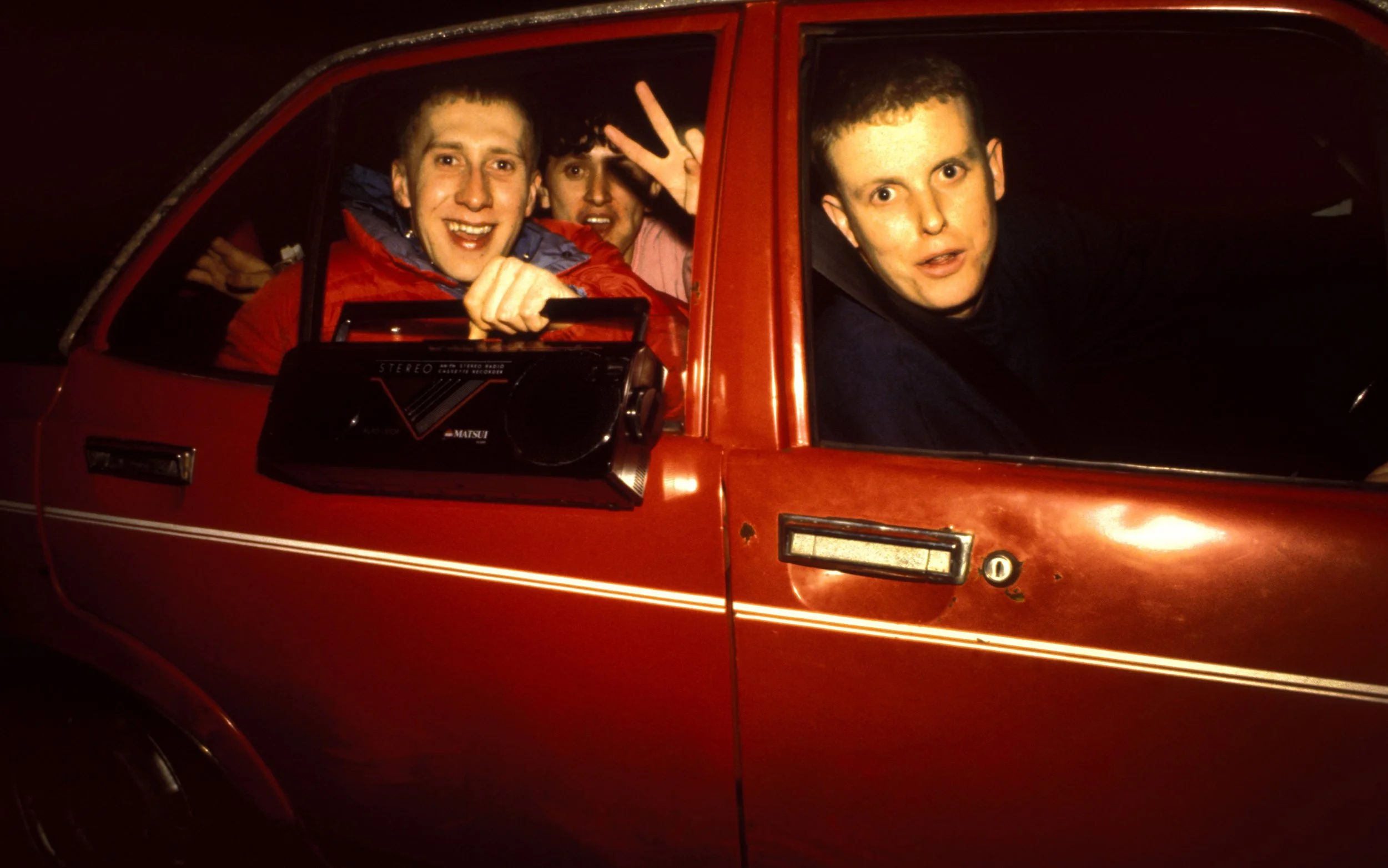
Projects Kavel Rafferty presents photographs from the archive of Tony Davis.
Tony Davis - 'The Way We Felt'
Post Office Gallery, 22-23 Cecil Square, Margate CT9 1BA
5th - 8th of June 2025
Tony Davis’ visceral photography doesn’t just show what early ’90s UK rave culture looked like—it captures how it felt. His zine UK Rave 1991 (Cafe Royal Books) documents the ecstatic energy of the Midlands scene. Raised on Nottingham’s Clifton Estate in the ’60s and ’70s, Tony’s first taste of subculture came through football terraces and Northern Soul all nighters.
Though he saw himself as an observer, his candid photos earned him a place among the ravers. Local clubs like Venus and Koolkat provided the backdrop, while wild nights like Coventry’s Eclipse offered unforgettable snapshots of joy, gurning, and chaos—“not a straight face in sight.”
Before focusing on nightlife, Tony was drawn to street photography and the everyday life of working-class Britain. His work remains a powerful testament to youth culture, from the football terraces, kids hanging out on the street, to free parties in Nottingham. Tony captured it all with warmth and honesty—revealing moments rooted in the places he knew best.
Tony has exhibited nationally; his work has been published widely in magazines and newspapers. Including, Mixmag, The Face, ID and DJ Magazine.
@tonydavisphoto
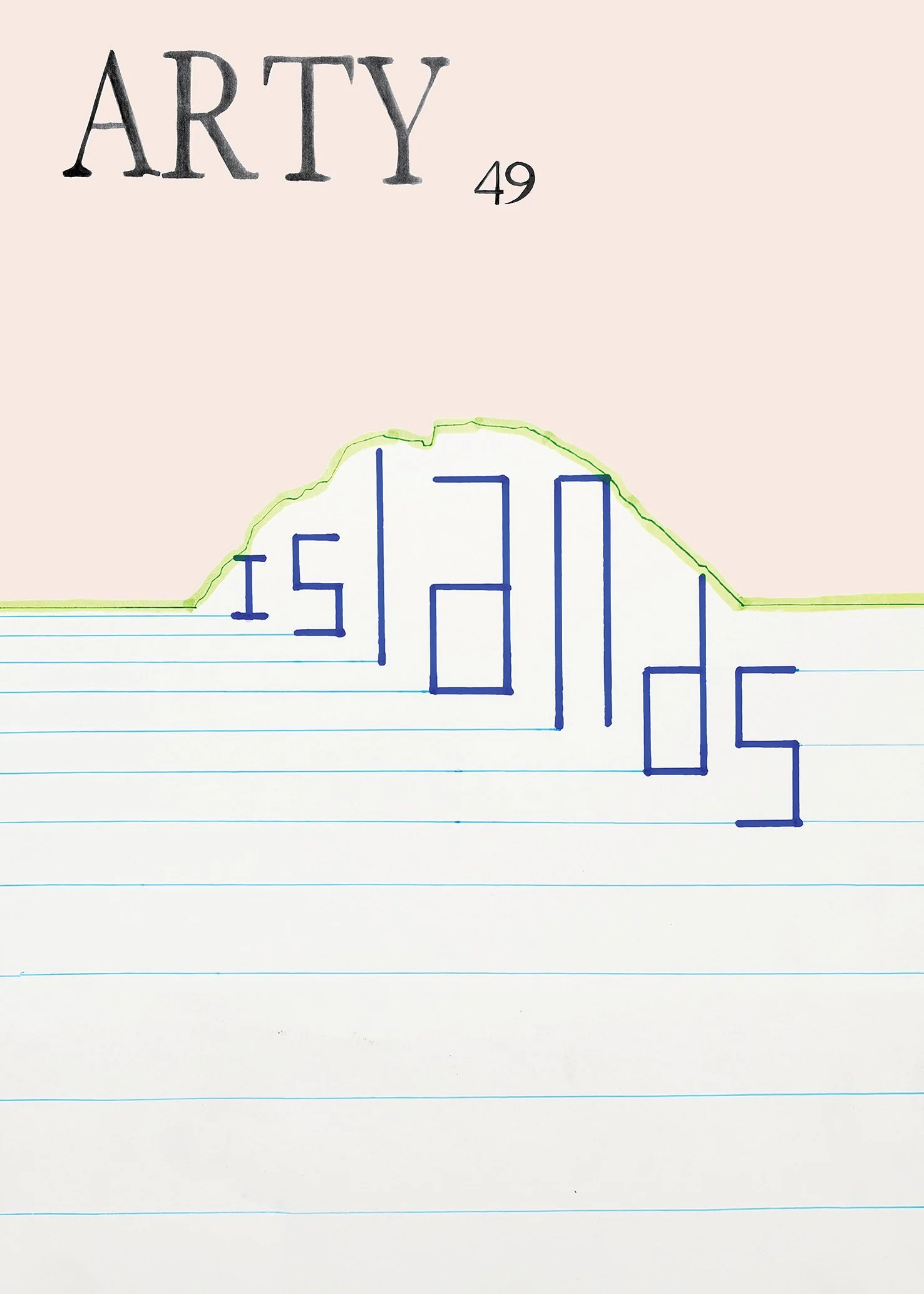
Kavel Rafferty And Transition Gallery Projects:
‘Islomania’
Paradise islands appear in our dreams as places that offer solace from the travails of everyday life. The reality is often much less idyllic. Islomania is a group show that considers islands from many different angles. Co-curated by Kavel Rafferty & Cathy Lomax it will be accompanied by a special Island issue of independent art zine Arty.
Post Office Margate, 22-23 Cecil Square, Margate, CT9 1BA Kent.
@projects_kavelrafferty
Anne Ryan, originally from Limerick, Ireland, now lives in London and Margate. Solo exhibitions include 'Tugann an Toreann’, Temple Bar Galleries, Dublin; 'Fighting on the Dance Floor', Exeter Phoenix Gallery (2022/23); 'Earthly Delites', Hastings Contemporary (2019/2020); 'The Cowboy Paintings', Turps Gallery, London (2017) and ‘A Barbarian at the Gate’ greengrassi (2017). The two-person commission, ‘Sirens’, Turner Contemporary, Margate, with Sophie Von Hellermann, ran from 2021 to 2023 with the work changing four times during the exhibition.
Cathy Lomax founded Transition Gallery in 2002 and is the editor of Arty and Garageland magazines. Lomax has a Fine Art MA from Central St Martins (2002), was an Abbey Painting Fellow at The British School at Rome (2014) and won The Contemporary British Painting Prize in 2016. In 2023 she completed a Film Studies PhD at Queen Mary University of London for which she researched the role of makeup and artifice in the creation of the Hollywood star image.
Ilona Szalay is a painter working in a range of media from canvas to tracing paper, LED light to glass. Her work engages the multitudinous dichotomies that make up both collective and individual subjective experience in restrained, poetic visual language. It is in liminal space – that between states of dominance and submission, or power and vulnerability – that the subjects in her work encounter one another.
Jennifer Caroline Campbell makes lumpy paintings and painty sculptures that question cultural hierarchies and normative modes of living via non-linear and fragmented story telling. Campbell graduated from the Slade in 2014 and is currently associate lecturer at Camberwell College of Arts and co-host on the Garageland Salon podcast. Recent solo exhibitions include ‘Cake Options and Escape Options’, Transition Projects, London (2024), ‘Ever After Slices’, Atalante, Gothenberg (2019) and ‘Glamorous’, Outpost Gallery, Norwich.
Kavel Rafferty is a self-taught, multi-disciplinary artist, working in collage, painting and assemblage art. Where possible Kavel uses discarded materials in her practice, a frugal and relevant way of working in a time of mass production and waste. Kavel runs the gallery space at the Old Post Office building in the centre of Margate.
Vincent Hawkins was born in Herts, England and studied painting at Maidstone College of Art, Kent from 1984-87. He lives in Margate and makes paintings on canvas paper and card. He has shown extensively in Britain and abroad including solo shows in Chicago and Paris in recent years.
@transitiongallery @projects_kavelrafferty @artyartzine @ilonaszalay @jennifer_caroline_campbell @vincent_hawkins_ @anne_ryan_painter
@cathylomax @kavelrafferty
22-23 Cecil Square, Margate, CT9 1BA
Private View May 10th, 6-8pm.
Open May 11th - May 25th, Thurs - Sunday 12 - 4pm.
Or by appointment.
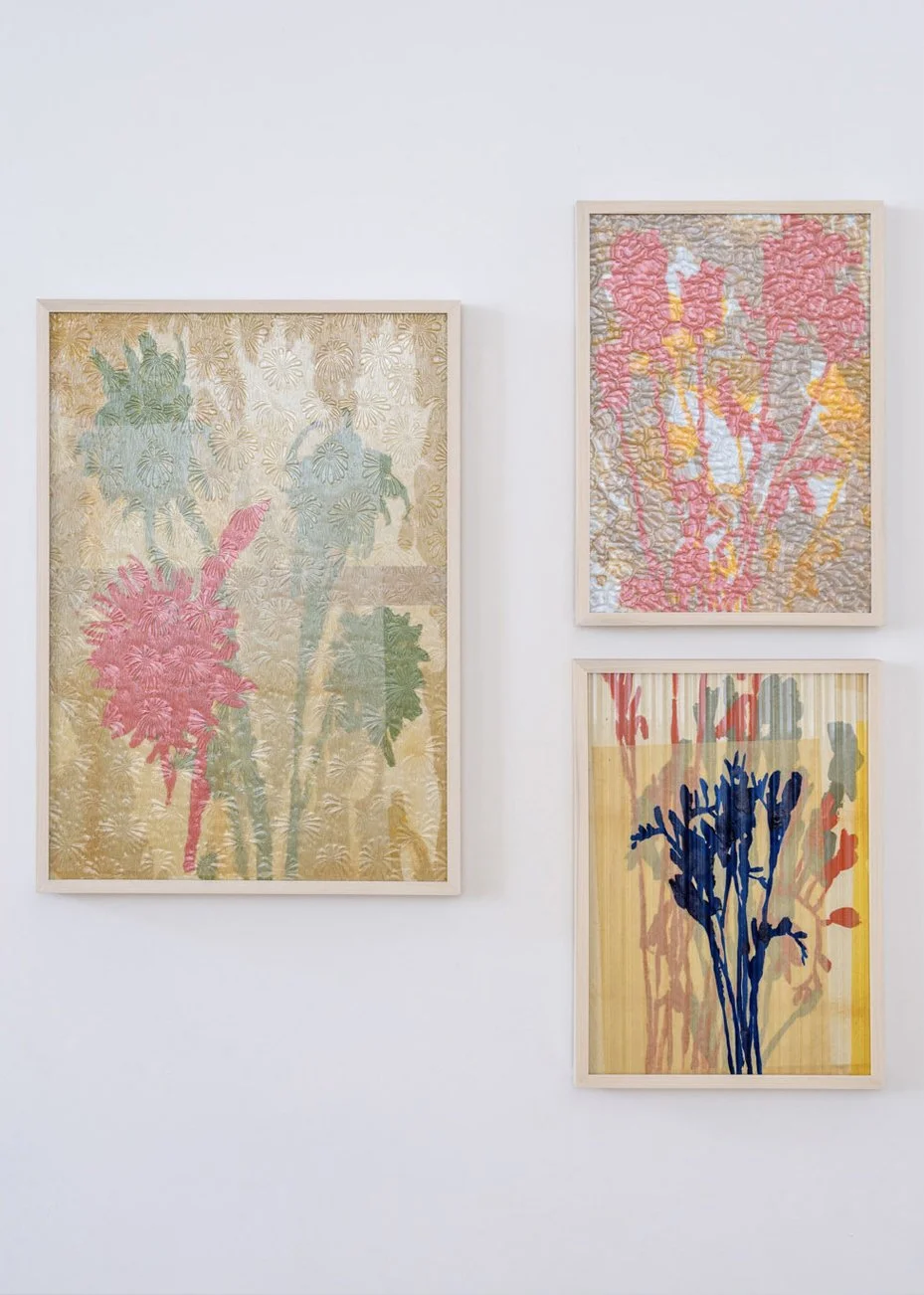
‘New Relief’ and ‘Shadow Flower’ - Mahal Kita X Kavel Rafferty - December 2024.
Shadow Flower - Kavel Rafferty - December 2024.
You must be quick, to capture the fleeting shapes.
Oil paint on salvaged tracing papers. The oil seeps from the edges to create a halo, the shadows move, pattern on pattern.
Over-lapping and under-lapping of chrysanthemums, carnations, lilies and asters - studies of sad supermarket flowers and the oft derided last-minute bunch from the garage forecourt. These bouquets are far from exotic, in this series Kavel makes the common place special.
These pieces explore the ubiquitous presence of textured glass in the domestic architecture of the UK, from porches and once fashionable serving hatches to steamy bathroom windows. These pieces both reveal and conceal, offering glimpses of the images whilst obscuring what lies beneath, creating a tension between intimacy and distance.
The textured glass layers pattern and distorts the surface of the paintings. This interruption invites the viewer to look again; speaking to both nostalgia and privacy.
This series also hints at the way nature is compartmentalised and controlled within suburban life. In this work the glass becomes part of the paintings, not just as framing and a protective material, but integral to the works.
New Relief - Mahal Kita - December 2024.
Flower installation by Margate Based Art Florists.

Photography Beth Saunders
‘CAN’T SLEEP’
by Maxine Sutton
October 26th - November 17th, 2024
Artist Maxine Sutton in collaboration with Projects Kavel Rafferty, is proud to announce ‘CAN’T SLEEP’, a new series of works. Running from October 26th to November 17th, this exhibition will feature a range of textiles and works on paper, weaving together domestic materials and discarded remnants to explore the intimate yet universal experience of sleeplessness. Maxine Sutton’s process involves re-purposing everyday fabrics, such as blankets, linens, and scraps from the past, to create intricate fabric compositions that distill her own sleepless nights - those foggy hours when worries and sensations blur the line between wakefulness and dreams. This combination of materials evokes the deep connection between memory, comfort, and anxiety, reflecting moments of both ease and tension experienced in the domestic sphere. “I am old enough to remember sleeping under layers of blankets and sheets, before we had duvets,” Sutton reflects. “There is always this anxiety as well as safety in the domestic realm, where all our lives are played out. These materials, often over-looked or discarded, hold my attention, acting as soft vessels for absorbing memory and emotion.”There are references to home sewing, folk art and indigenous crafts. Alongside contemporary abstraction, Sutton’s works delve into themes of surrealism, nature, and the body’s interaction with the environment. In CAN’T SLEEP, the physicality of the body takes centre stage: the hands that create, the eyes that struggle in the dark, the ears that pick up muffled sounds. With thoughts of worry dolls and textile amulets, scraps are re-purposed as symbolic carriers of emotions, creating works that explore sustainability, leftover materials, and the subconscious mind. The work reflects on the experience of sleep, where night time sounds, light, and colour play significant roles. Felt and blankets suggesting a sense of muffled acoustics, further amplifying the sensations that come with sleeplessness. With a tactile and sensory engagement, the works are rooted in the physical experience of the body during these wakeful nights.
Maxine Sutton is a UK-based artist known for her mixed-media textile works, which merge traditional craft with contemporary concerns. Her practice is informed by memory, sustainability, and the emotional significance of everyday materials. CAN’T SLEEP is her latest exploration of the connections between the domestic, the body, and the subconscious mind.
Dates: October 25th - November 17th, 2024
Opening Hours: Friday-Sunday 12pm - 4pm or by appointment. Contact: kavel72@gmail.com

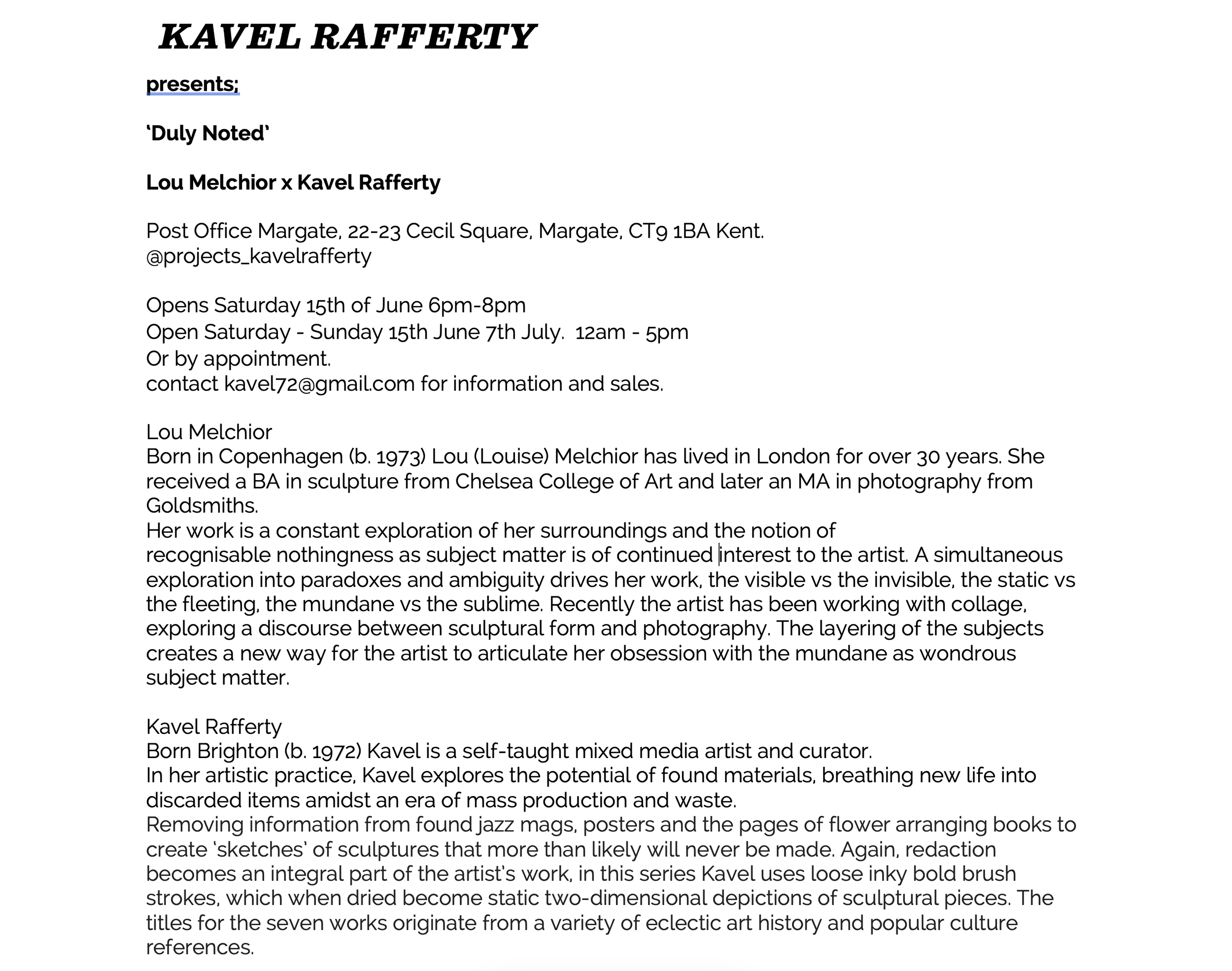
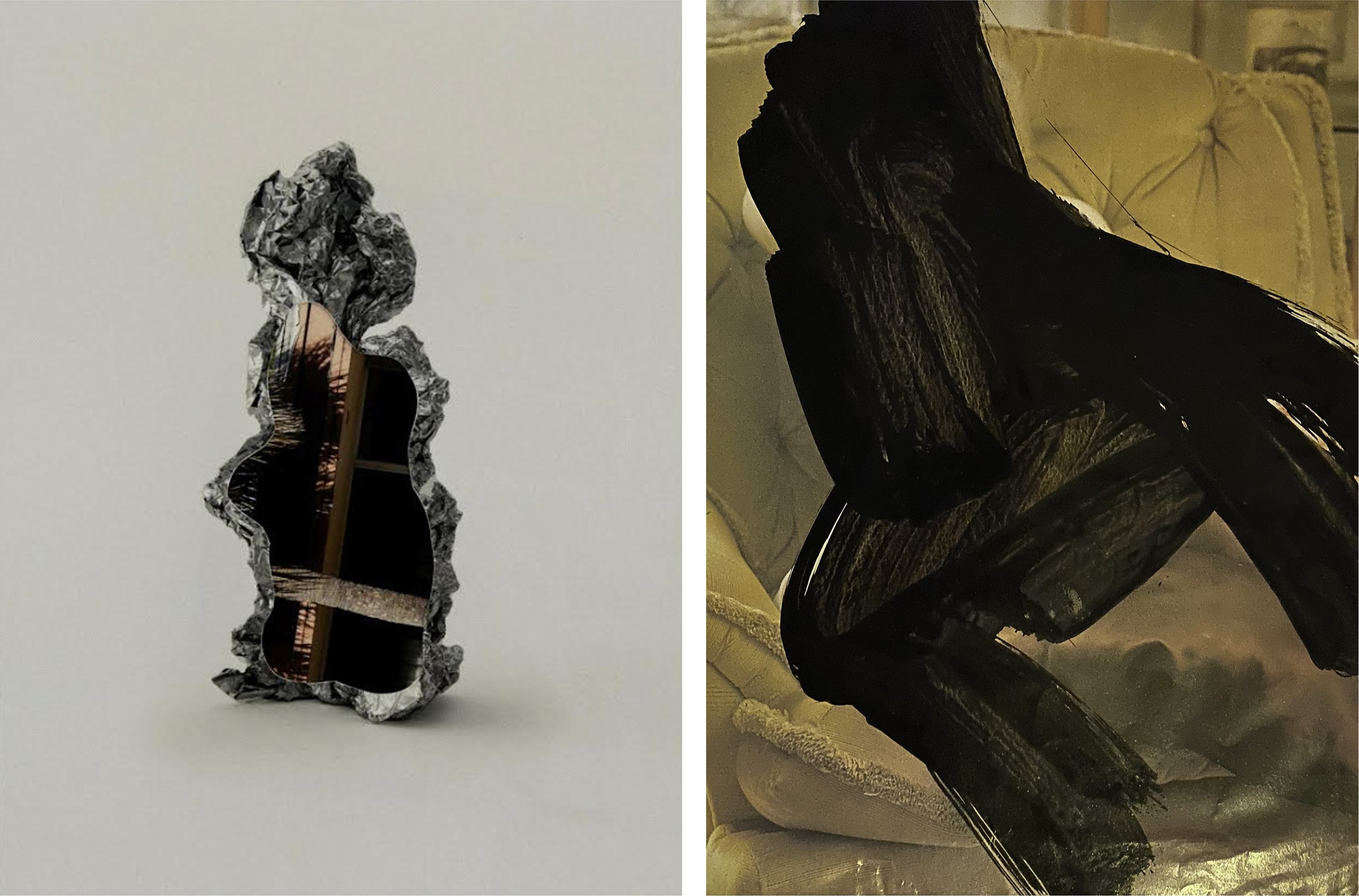
Lou Melchior and Kavel Rafferty


´A Blueprint for Living´ Rhiannon Adam
August 2023 - ´A Blueprint for Living´ Rhiannon Adam
A Blueprint for Living is a new body of work created to coincide with Margate Pride. The show explores the intersections between photographic process, colour, technology, and history to present a queer blueprint for happiness – a blueprint that has been conspicuous in its absence, with queer lives being forced into secrecy, and a generation decimated by the AIDS crisis.
As with all of Adam’s work – the choice of photographic process is symbolic. Polaroids are presented as a nod to subversive under-counter exchanges when homosexuality was still criminalized and Polaroid’s one-off untraceable nature freed their creators from culpability. Here Polaroids celebrate queer representations out in plain sight. At the back of the space, heat activated dyes are used to conceal and reveal latent images and text through physical touch and interaction, alluding to the contact and exchange between queer bodies that was once so feared. Cyanotypes – the show’s driving force – play the part of the missing blueprint, defiantly celebrating the visceral queer joy encapsulated in Adam’s archive of imagery of queer nocturnal worlds. The irregular smears of blue and irregular hang of the images alluding to the chaos and expressiveness of queer spaces.
The cyanotype process is one of the earliest photographic mediums. In the very beginning, they were used as an accessible means of categorization and documentation of nature, as seen in Anna Atkins’ work (Photographs of British Algae: Cyanotype Impressions, 1843). In using this same technique, the artist creates an alternative past, where queer lives are documented, and deemed “natural”. The reproducibility of the cyanotype – also used as an early form of photocopying – serves as a protest against the historic invisibility of queer people.
In 2023, we are under threat from ever-more insidious forces, with biases reinforced through machine learning. AI systems have highlighted the hypernormalisation that forms the collective knowledge base. Within the world of AI, an image prompt for a “happy couple” includes only images of heteronormativity. In the process of preparing this show, AI image generators were prompted by the artist to create images of queer happiness – with the often-poor Bacon-esque results revealing perception gaps within the systems themselves, feeding off of negative media. Instead of enshrining this distorted vision in the show, the artist took a new approach – reimagining political and historical figures with well established anti-LGBTQ+ track records as allies, recreating history – a way of winding back the clock to imagine a world where queer freedom and equal rights could have existed.
The collected work is also a rumination on the world’s favourite colour. Here, it is an ode to Derek Jarman’s era-defining work, Blue (1993), (originally planned to be named A Blueprint for Bliss) where Jarman’s degradation of sight as a result of AIDS is framed by the colour blue. It is also a reappropriation of the colour of the conservative party – the party responsible for Section 28, the first piece of anti LGBT+ legislation this country experienced in a century, the party now responsible for blocking reforms to the gender recognition act.
This text was in part created by Chat GPT, in an effort to train and reeducate the AI system, forcing it to acknowledge and absorb the reality of queer legacies, and encourage algorithmic diversity.
@rhiannon_adam
Photography Beth Saunders
May 2023 - ´The Florist´ Kavel Rafferty
‘The Florist’
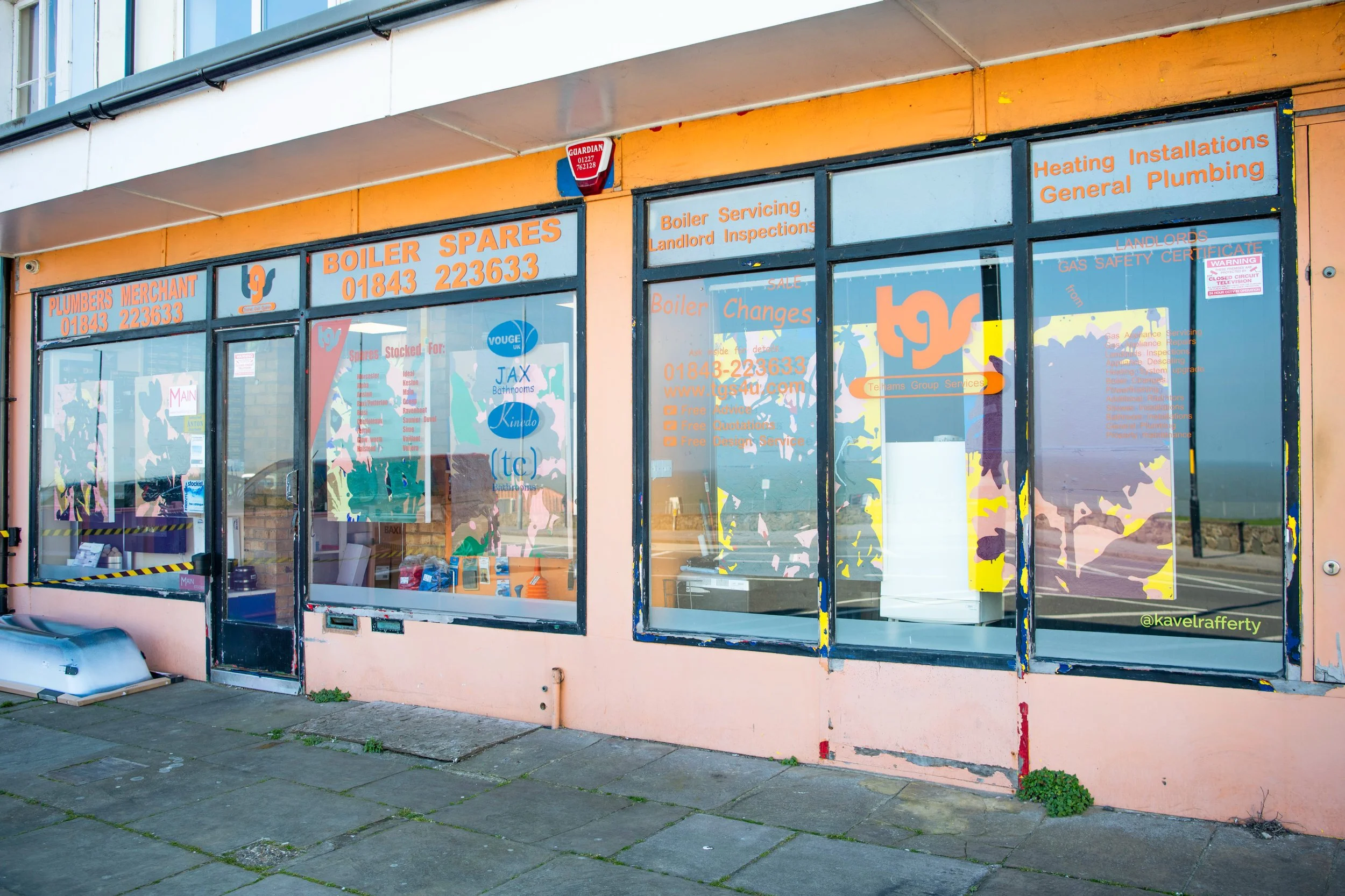
With this new installation @projects_kavelrafferty explores the democratisation of art – suggesting that art does not always have to be viewed on white walls. So the weather-beaten faded orange facade of the plumbers’ merchant on Cliff Terrace, Margate, becomes a gallery.
Art can be shown in unexpected places, at street level – in this case the traditional gallery space is usurped by a plumbing supplier, bringing to mind the well-worn trope of a weed growing from a crack in the concrete, flowers placed amongst the mundanity of trade. Passers-by, errand-runners, coffee addicts and afternoon Aldi shoppers are the audience and critic.
These original, large scale flower paintings flourish and bloom in the un-altered windows, next to the old boiler, behind the plumbing graphics, amongst piles of pipes, plastic fixings and tools.
These questions persist: where does art belong, where does it thrive, how is it seen and who sees it?
Flower paintings, acrylic paint, gloss paint, rubber paint, on found cardboard and original Margate beach hut wood.
Thanet Gas Spares, 2 Cliff Terrace, CT9 1RU, Margate. 18th April - 28th May
March 2023 - ´Fancy´ Paris Essex in Margate.
Kavel Rafferty brings the joyful, sassy and extraordinary work of knit and crochet artists Carolyn Clewer and Tiphaine de Lussy - founders of Paris Essex - to 231 Northdown Road, in Margate. Paris Essex are Essex girl, Carolyn Clewer and Parisienne, Tiphaine de Lussy, The result of years of creative collaboration between the two knitwear and textiles specialists, which began decades ago at the Royal College of Art. Paris Essex revisits the craft and clichés of knitting and crochet, working with combinations of hand and machine techniques. They share a visual language and are drawn to the materials, processes and pace of fashion. They work in a space where distinctions between craft, design, fine art, and low culture are blurred and of equal worth.
Recent works are a series of unashamedly joyful and exuberant woolly pieces. Scaled-up crochet techniques from 1970s craft books have been combined with recognisable 1980s domestic knitting-machine patterns. Rather than rejecting and avoiding outdated and sexist ideas of women’s crafts and home-making from their childhood, they have found themselves paying respects to all forms of domesticity and are playfully nostalgic for feminine stereotypes that they used to avoid.
Working in textiles and specifically with hand crochet and domestic knitting machines, they have been immersed in the world of hobbies and home-craft for years, whether they liked it or not. Like a scroll through lockdown social media tutorials, the imagery in their work embraces the enduring joys of flower-arranging, pottery, cat-lovers and make-up tutorials.
December 2022 -´Bunch’ Co curated with Louise Fitzjohn of Liminal Gallery. Eight women and non-binary artists show at to 231 Northdown Road, Margate, Kent UK.
A collaborative exhibition ´Bunch’, which brings together the works of Liz Crossfield, Mafalda Figueriedo, Kavel Rafferty, Cherelle Sappleton, Tracey Slater, Jeni Snell, Alexis Soul-Gray and Olivia Strange. The multimedia exhibition of eight women and non-binary artists spans drawing, collage, painting, print and sculpture. The exhibition title ‘Bunch’ refers to ‘a number of things closely grouped together’ and the two curators, Louise Fitzjohn and Kavel Rafferty, bring together a variety of contemporary artists working in surprising and nuanced ways. Binding and bridging; the works selected create connections, conversations and relationships between the artists and the curators.
August - Sept 2022 ´Les Painters’ Three queer women painters. As part of the Margate Pride Art Map Kavel Rafferty brings together three lesbian artists that use paint in their work.
Jane Dinmore uses vibrant colours and shapes to create animated compositions, which are witty narratives full of energy, momentum, concealment and possibility. Her paintings on canvas and drawings on paper use a cartoon language that favour the absurd, resulting in a mix of the comic and joyful abstraction. The work in this show focuses on people obviously hiding what we can’t ignore, so shoving it literally under the carpet. Jane is interested in hiding messy thoughts as beautiful sculptural lumps and nonsense to be misunderstood.
Mia Pollak (Signs by S&K) plays with the semiotics of type and the distant but sometimes-familiar language of Yiddish, Mia employs traditional signwriting glass techniques to present them.
Kavel Rafferty's latest work investigates the culture of toxic positivity, oppressive wellness, motivational memes and affirmation overload. Kavel questions the validity and usefulness of these banal phrases and feel good messages, by redacting found vintage posters with gloss paints. Taking a wry look at this moral messaging and pseudoscientific babble by reverse highlighting the lettering obliterating the imagery. Rafferty is not unaware of her own gullibility and attraction to quick fix cod psychology, with these works she gently laughs at her own self-help addiction...
April 2022 - May ‘Cats In Crisis’ (Two person show) to 231 Northdown Road, Margate, Kent UK.
‘I postulate that cats started as psychic companions, as familiars, and have never deviated from this function’ William S. Burroughs ‘The Cat Inside’
‘Cats in Crisis’ the opening exhibition at Hotel Michele takes its title from charitable organisation that once occupied the shop opposite, and brings together new works by Kavel Rafferty and Thelma Speirs that marks a shift in direction, from commercial illustration and fashion towards making as artists for exhibition spaces.
Thelma Speirs presents us with a series of abstracted pop portraits made up of commonplace children’s stickers that convey observations she has made of the cats she has known and loved. Swapping the pencil, the brush and more recently the etching plate for these stickers, the artist seeks to capture the unruly nature of her subjects; Captain, Didi, Kelloggs, Mimi, Mouse, Skipper & Ted.
Kavel Rafferty's cat as muse.